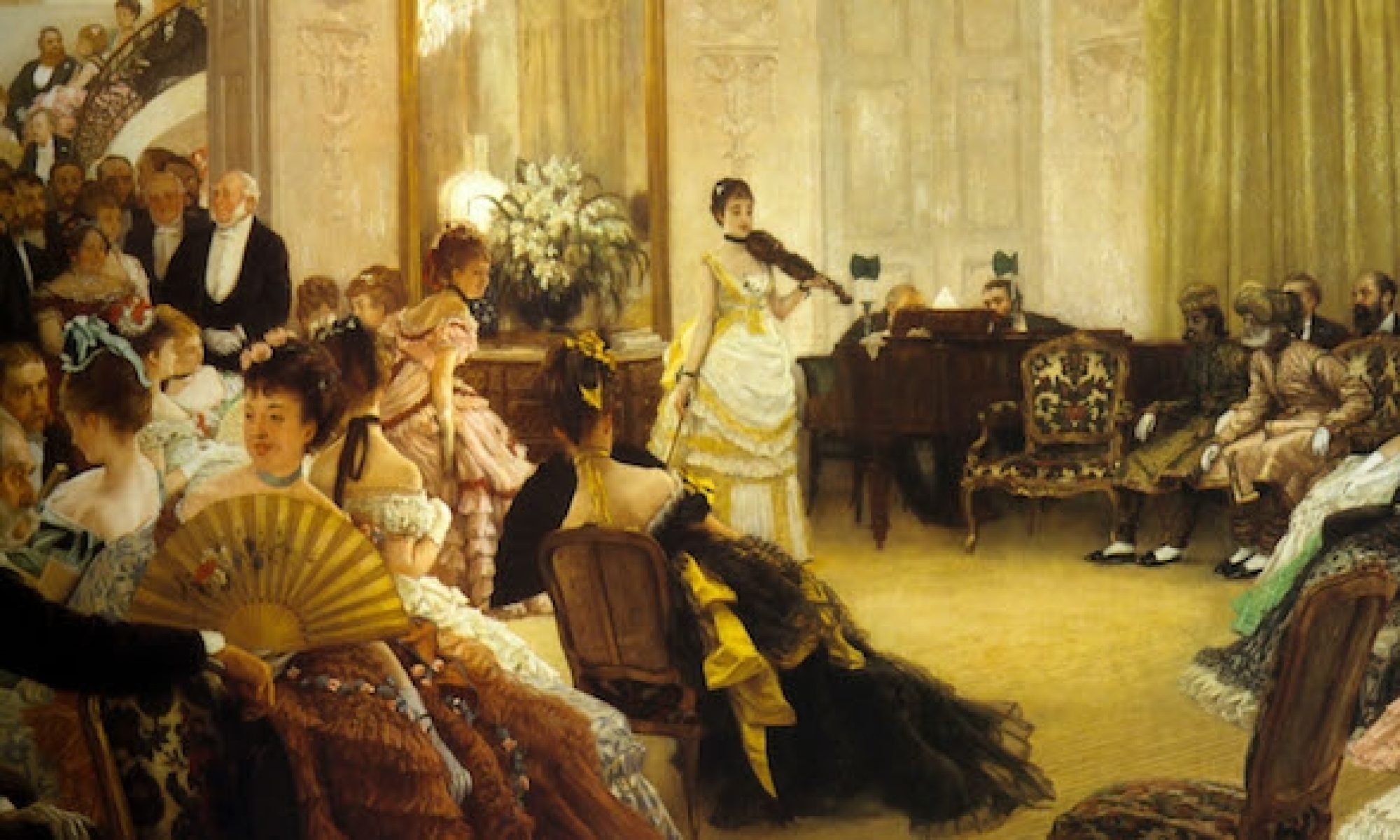
The romantic era marked by academic, artistic and musical changes were accompanied by broader social and political change. The musical movement demonstrates a literal expansion of pre-existing genres and forms. The aristocratic and noble class still highly influence the society, but enlightenment and revolutionary ideas start emerging as well as a new middle Bourgeois class. Such political and social changes impacted the musical world and also indirectly the development of musical instruments.
In the romantic era, the violin gained prominence as a solo instrument as composers wrote increasing technically demanding concertos, sonatas, show pieces, chamber and orchestral parts. This is not to diminish the role of the violin in the baroque era, but I would like to demonstrate the correlation between the physical developments of the instrument with an increase in pieces that showcase the virtuosic nature of the violin.
Beethoven’s Kreutzer Sonata (1803) is an excellent example for displaying the increased demands on the violinist
It is unprecedented in regards that even earlier Beethoven Sonatas were extremely piano heavy and less virtuosic in the violin part (Lockwood, 83). This particular recording by Ms. Kopatchinskaja really stands out to me as she brings extreme passion, drama and tension to the music. The Kreutzer Sonata begins with an introduction containing a violin cadenza in major, followed by a piano cadenza in minor. The two instruments engage in a dialog and increase the tension until the energetic breathless Presto main theme as seen in the score. Especially virtuosic is are the fast eighth note passage that require string crossings between two string for each consecutive note (1:45). Also, the drastic character changes abruptly from one measure to the next require extreme control and precision. One example is at the end of the first theme around 2:10 in this recording, which then seamlessly melts into a tranquil and almost nostalgic second theme area. Another example is at 2:58 where the character changes quickly from a hoarse anxious G-string sounds. Lastly, I believe the use of pizzicato strives to ‘imitate’ the way the piano can roll big chords, and therefore showcasing a ‘newer’ violin technique.
Physical Developments of the Violin
The most physical changes were implemented over the span of c.1760 to c.1830. Most of the changes pertained to the neck of the instrument including lengthening, slightly increasing the angle, and tapering the end of the neck (Stowell, 33). Another adjustment included a thinner and more curved bridge, although the body of the instrument stayed largely unaltered. These changes resulted in an increased playing length and enabled increase agility, brilliance and power. The differences between the baroque violin and modern violin are shown in this photograph.

Development of the chinrest during the classical era
Other changes to the instrument include the development of the chinrest during the classical era. Musicians had different approaches towards holding the instrument. Although it seems clear that the violin was held between the jawbone and the collarbone, the placement of the chin to the left, right or on top of the tail-piece seems to have varied even in the second half of the 18th century (Nelson, 84).
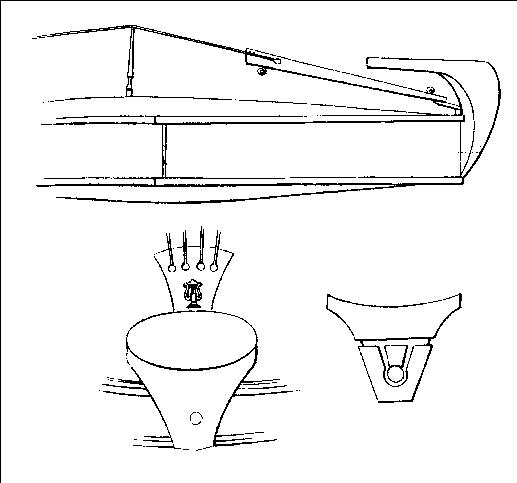
Chin-rest or ‘fiddle holder’ as ilustrated by Spohr in his ‘Violin-Schule’ (1832)
The development of the chinrest by Louis Spohr as depicted in this diagram eventually lead to a more standardized placement of the chin and provided physical stability for musicians playing orchestral pieces. According to Nelson, “The symphony (Schubert C major) contains very few rests for string, and without the stability given by modern chin-rests and shoulder-pads the repeated triplet figures in various positions must have been extremely exhausting”, especially considering marathon concerts that existed in the 19thcentury (Nelson, 136-138).
It is interesting how the development of the violin repertoire and technology went alongside a shift in its own social status. The violin had been viewed as a ‘lowly dance instrument’, but by the 19th century it was a prominent part of ‘Western music’, and gained social and cultural status (McVeigh, 46). The violin became a status symbol as it was an instrument than noblemen learned as amateurs. This shows how music was and remains inseparable from outside factors such as the society, culture, and economy. The development of the violin did not occur in a vacuum, but instead occurred in conjunction with musical progress of the time.

In Contrast to:

“Chin-rest or ‘fiddle holder’ as ilustrated by Spohr in his ‘Violin-Schule’ (1832).” Grove Music Online. . Oxford University Press. Date of access 23 Mar. 2020,
Lockwood, Lewis, and Mark Kroll. The Beethoven Violin Sonatas: History, Criticism, Performance. University of Illinois Press, Urbana, 2004.
Nelson, Sheila M. The Violin and Viola. Benn, London; New York;, 1972.
Stowell, Robin, editor. The Cambridge Companion to the Violin. Cambridge University Press, 1992.
Stowell, Robin. The Early Violin and Viola: A Practical Guide. Cambridge University Press, Cambridge; New York;, 2001, doi:10.1017/CBO9780511481833.
I really like your topic! I was researching for my final project and was also reading something related — the development of instruments through the late 18th century to the 19th century and how that is shown in the repertoire/compositions. I especially like the two pictures you post showing the difference between social status, which is influenced by the development of the violin repertoire and technology! I think that the development of the instrument also contributes to more challenging repertoire (richer texture/technically more difficult/more demands on varieties of sound) to be written. In addition, changes in society and development of music technology helps develop the instruments as well.
I learned a lot from your blog post, I didn’t realize how drastic and monumental the metamorphosis of a violin could be but it sure seems as though the physical adjustments sparked the alteration of musical style, as well as cultural and social style. Very engaging and thought provoking as well. It makes me think…what could the future present for new violin developments and how will that in turn spark new musical and/or social styles as well?
I really enjoy reading your blog. The way how you explain the musical and instrumental changes of violin is very logical. The pictures and illustrations in each sections are all very engaging, especially the one shows the physical development of violin, it helps me to understand how it changed more clearly. And I think you could explore more on the change of how the violin sound because of its physical development. Whats the difference between the sound and why did it change. Maybe the change of the sound contributes to more gernes of music and violin techniques.
I really like learning about the development of the instruments that we are playing currently! These slight changes in the violin result in a vast number of different possibilities which is astounding to see. I really liked how you were able to talk about the technological changes in the violin as well as the changes in music and role of violins side by side.
Hi Karen! Your blog post was really informative to me, because I didn’t realize that the violin had gone through changes physically but especially socially. I found the chin rest part rather interesting, because I never knew how important it was for stamina and getting through technically difficult passages. When I watch a violinist play a lengthy concerto, it never occurs to me that a lack of a chin rest would make things that much more difficult.
This is a very informed blog post. I enjoyed reading it and learned a lot. I had no idea that there was debate on how to properly hold a violin. What I found even more shocking was that up until the nineteenth century violinists played without a chin rest.
Have you ever tried playing without a chin rest? Is it very difficult? It sounds impossible to me.
Reading that the violin was considered to be a ‘lowly dance instrument’ made me curious as to why there a shift in attitude towards it.
Do you know what caused the sudden admiration for the violin? Is it purely the difference in sound quality compared to the Baroque violin?
This was a very easy to understand and well organized blog post about the history of violin. It was easy to understand with all the pictures that you found and attached.
I think it would be also nice to include what triggered these specific changes over time, and how it affected repertoires for the violin. Did it widen the style of performance, the kind of sound produced, etc.
Hey Karen, I enjoyed reading your post about the development of the violin both in the physical aspect and the social aspect. As a fellow violinist, it made me think more about the importance of knowing the changes that happened to the instrument and why it did. I personally think that the violin has a lot of potential to grow in the future. What do you think about the future development of the violin?
Hi Karen! This was a very informative blog post. I had never considered how a physical instrument might change to meet the needs of more demanding music. It’s also interesting how something that looks like a small change (like the angle of the neck or bridge) could make such a big difference. I wonder if all of the equipment that musicians buy nowadays that promise to make something in your playing better is going to end up furthering the evolution of instruments, or if they’re close to the end of their evolution and now musicians are just making adjustments for their personal setups. Really nice job!
It is fairly interesting that we could see such a drastic change of the development of violin in both its shape and its use, I think it also demonstrates the aesthetic value of people in different time period and it shows what effect does people focus in different time period. Romanticism period focus on extreme expressiveness , and this changed the roles of some instruments, for example, violin, to meet the demand of extreme expressiveness.there might be more drastic change in the future instrument, there is many change that occurred in instruments now, for example, the development of electronic instruments.
I really enjoyed reading your post! I really didn’t know anything about the development of the violin so this was very informative for me. It sounds a lot like the development of the piano. Both instruments needed to adapt to the change in compositional style for their time. For example with Beethoven, he was always demanding more and more sound from his piano so pianos had to be made bigger and louder.
Hi Karin! I really enjoyed reading your blogpost about how the development of chinrest influenced the violin repertoire and performance. Because I play the violin as well, it made me wonder how people were able to perform virtuoso pieces before chinrest was invented. Although Beethoven’s Kreutzer Sonata (my favorite Beethoven sonata!) does demonstrate a huge change in the violin repertoire and the level of virtuosity, I believe there were virtuoso pieces written before that time as well. Perhaps they are different types of virtuosity, but Vivaldi’s Four Seasons written in 1716-1717 also shows high technical demand with incredibly fast passages and wide variety of range (there are many upper position notes throughout the strings). Because there have been technically demanding pieces written before the development of chinrest, it was very interesting to think about how much the violinists would have struggled with discomfort before the chinrest was invented!
I really enjoyed reading your blog post! It was interesting to think about how the demands of the music forced the baroque violin to evolve, especially as the role of the violin changed throughout the years. I always assumed the violin made incremental changes over the years to produce better sound, but I never thought about what might’ve prompted those changes. Do you think the violin can evolve still? Have the demands of virtuosity risen since then and if so, do you think the modern violin can meet those demands?
I really enjoyed your blog post. It was very easy to understand how the violin developed physically and status-wise. I had no idea that violin was a “lowly dance instrument” because how we view the violin is so different now. I think it would have been more interesting if there were more examples of repertoires that represent before and after of violin’s physical development.
Hey Karin, great blog post. While I knew the neck of modern instruments is a little longer than baroque violins, I didn’t know that the angle was changed as well and found that very interesting. I’m curious to know if the change between baroque and modern violins was gradual or if there was someone who “invented” the modern violin. Also I’m curious to know how long after modern violins began to be made regularly that baroque violins were still in widespread use. In general I thought you laid out your information very clearly and I really liked the visual examples you gave.