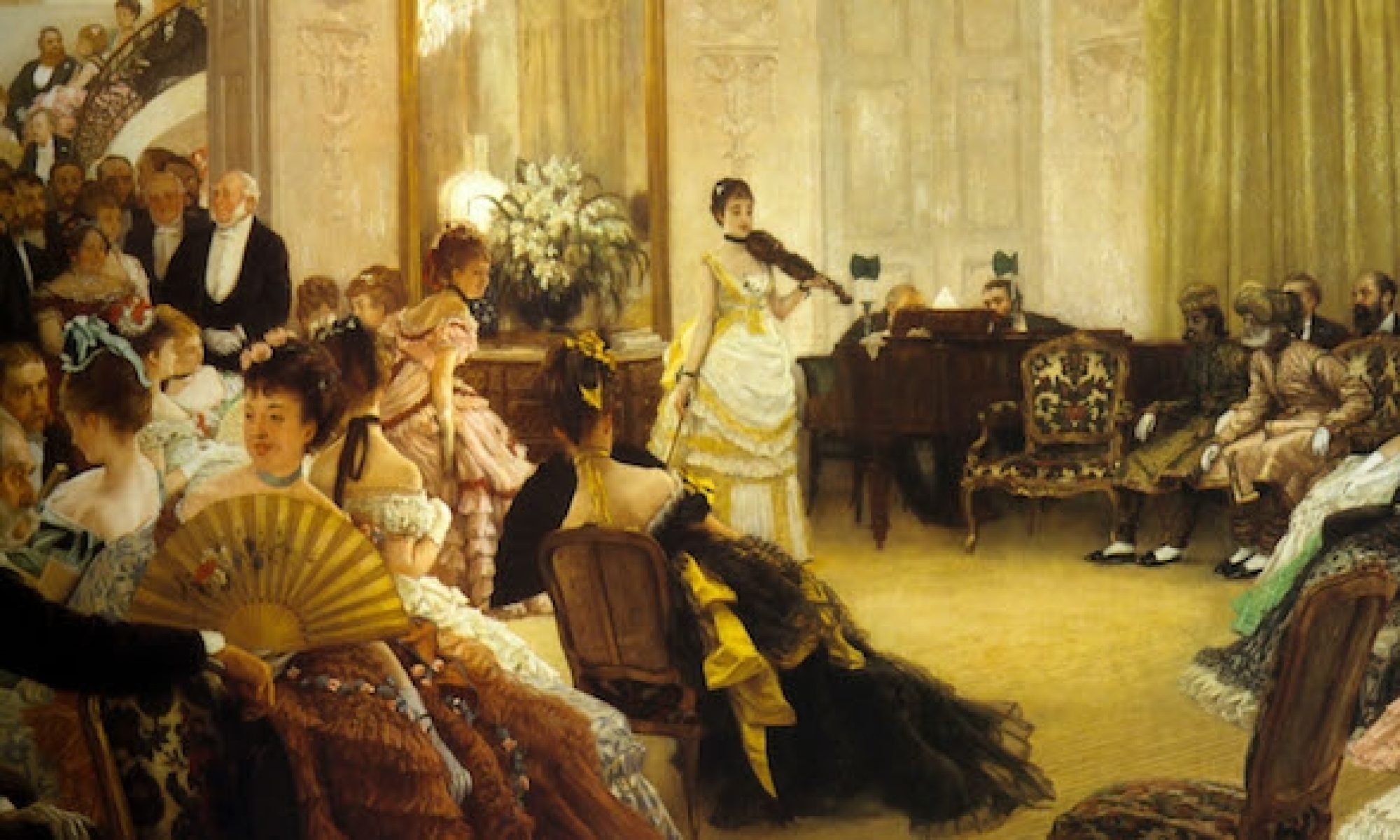
The romantic era marked by academic, artistic and musical changes were accompanied by broader social and political change. The musical movement demonstrates a literal expansion of pre-existing genres and forms. The aristocratic and noble class still highly influence the society, but enlightenment and revolutionary ideas start emerging as well as a new middle Bourgeois class. Such political and social changes impacted the musical world and also indirectly the development of musical instruments.
In the romantic era, the violin gained prominence as a solo instrument as composers wrote increasing technically demanding concertos, sonatas, show pieces, chamber and orchestral parts. This is not to diminish the role of the violin in the baroque era, but I would like to demonstrate the correlation between the physical developments of the instrument with an increase in pieces that showcase the virtuosic nature of the violin.
Beethoven’s Kreutzer Sonata (1803) is an excellent example for displaying the increased demands on the violinist
It is unprecedented in regards that even earlier Beethoven Sonatas were extremely piano heavy and less virtuosic in the violin part (Lockwood, 83). This particular recording by Ms. Kopatchinskaja really stands out to me as she brings extreme passion, drama and tension to the music. The Kreutzer Sonata begins with an introduction containing a violin cadenza in major, followed by a piano cadenza in minor. The two instruments engage in a dialog and increase the tension until the energetic breathless Presto main theme as seen in the score. Especially virtuosic is are the fast eighth note passage that require string crossings between two string for each consecutive note (1:45). Also, the drastic character changes abruptly from one measure to the next require extreme control and precision. One example is at the end of the first theme around 2:10 in this recording, which then seamlessly melts into a tranquil and almost nostalgic second theme area. Another example is at 2:58 where the character changes quickly from a hoarse anxious G-string sounds. Lastly, I believe the use of pizzicato strives to ‘imitate’ the way the piano can roll big chords, and therefore showcasing a ‘newer’ violin technique.
Physical Developments of the Violin
The most physical changes were implemented over the span of c.1760 to c.1830. Most of the changes pertained to the neck of the instrument including lengthening, slightly increasing the angle, and tapering the end of the neck (Stowell, 33). Another adjustment included a thinner and more curved bridge, although the body of the instrument stayed largely unaltered. These changes resulted in an increased playing length and enabled increase agility, brilliance and power. The differences between the baroque violin and modern violin are shown in this photograph.

Development of the chinrest during the classical era
Other changes to the instrument include the development of the chinrest during the classical era. Musicians had different approaches towards holding the instrument. Although it seems clear that the violin was held between the jawbone and the collarbone, the placement of the chin to the left, right or on top of the tail-piece seems to have varied even in the second half of the 18th century (Nelson, 84).
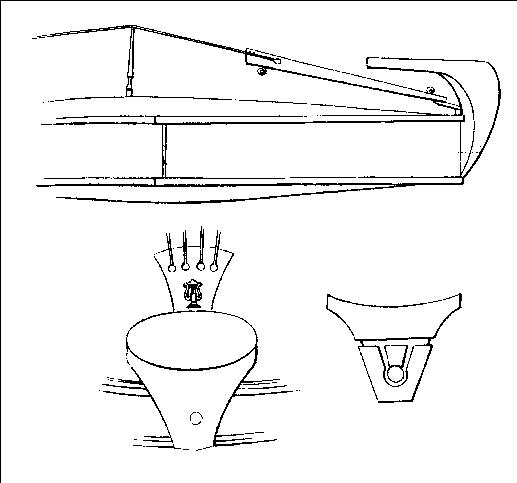
Chin-rest or ‘fiddle holder’ as ilustrated by Spohr in his ‘Violin-Schule’ (1832)
The development of the chinrest by Louis Spohr as depicted in this diagram eventually lead to a more standardized placement of the chin and provided physical stability for musicians playing orchestral pieces. According to Nelson, “The symphony (Schubert C major) contains very few rests for string, and without the stability given by modern chin-rests and shoulder-pads the repeated triplet figures in various positions must have been extremely exhausting”, especially considering marathon concerts that existed in the 19thcentury (Nelson, 136-138).
It is interesting how the development of the violin repertoire and technology went alongside a shift in its own social status. The violin had been viewed as a ‘lowly dance instrument’, but by the 19th century it was a prominent part of ‘Western music’, and gained social and cultural status (McVeigh, 46). The violin became a status symbol as it was an instrument than noblemen learned as amateurs. This shows how music was and remains inseparable from outside factors such as the society, culture, and economy. The development of the violin did not occur in a vacuum, but instead occurred in conjunction with musical progress of the time.

In Contrast to:

“Chin-rest or ‘fiddle holder’ as ilustrated by Spohr in his ‘Violin-Schule’ (1832).” Grove Music Online. . Oxford University Press. Date of access 23 Mar. 2020,
Lockwood, Lewis, and Mark Kroll. The Beethoven Violin Sonatas: History, Criticism, Performance. University of Illinois Press, Urbana, 2004.
Nelson, Sheila M. The Violin and Viola. Benn, London; New York;, 1972.
Stowell, Robin, editor. The Cambridge Companion to the Violin. Cambridge University Press, 1992.
Stowell, Robin. The Early Violin and Viola: A Practical Guide. Cambridge University Press, Cambridge; New York;, 2001, doi:10.1017/CBO9780511481833.