The Origins of American Folk Music

Ah, American folk music. I can practically hear the bald eagle screeching in the distance. If you’re anything like me, the idea of American folk music might be encapsulated by this scene from the movie Deliverance.

According to YouTube user Snap, “This is the most American thing ever.”

Folk music is often considered to represent the essence of a culture. More realistically, however, it represents an idea of the most “simplistic” lifestyle that exists in a culture (the people living that lifestyle being the “folk”). We know that most Americans aren’t banjo playing residents of rural Georgia, but that’s where our imaginations go when trying to picture a watered-down version of the United States. That’s in part why American folk music is and has always been so closely associated with the rural south. Surprisingly, though, the rural south is not where most American folk music originated.

Over the course of American history, the idea of who the “folk” are has changed. To the first colonists of the United States, the “folk” were Native Americans. Their culture seemed simple and “different” to the colonists, so they became the “others.” Not soon after colonization, it was European immigrants who became the “folk.” The final resting place for the “folk” in early American folk music was slaves, and, later, black people in general. Throughout the process of othering these different sets of people, early Americans mimicked and imitated components of their music in an attempt to evoke the essence of the “folk.” For this reason, it is important to recognize that much of what is considered to be early American folk music is actually taken from the traditions of people that early Americans looked down upon.

A Messy Origin Story

The origins of American folk music beg the question of whether it is uniquely American or hardly American at all. Similar to a lot of aspects of American culture, much of American folk music did not originate in the United States. Some of the staples of folk music in the United States were either lifted directly from other countries or were modified based on pre-existing instruments and songs. For the sake of ruining everyone’s sense of identity, I’ve picked a couple of components of American folk music that came from elsewhere.

The Banjo

Earlier I cited the banjo as a telltale component of American folk music. Originally, though, the banjo was derived from an instrument brought to the United States by slaves from Africa. West African folk music used a unique set of instruments for accompaniment, the most common of which was the bania (pictured left). It was from modifications to the bania that the banjo came to be used as an accompanying instrument in early American folk music. The banjo was certainly not the only aspect of American folk music to come from Africa. In the collection Roots of Black Folk Music in America, the producer (Samuel Charters) chronologically detailed the evolution of black folk music in America, beginning with African music and continuing all the way through to 1972. It becomes clear through this collection how much of what we consider to be “American” music is actually rooted in African tradition.

The Melodies

Most early American folk music tradition came from Great Britain, Scotland, and Ireland. According to musicologist Bruno Nettl, “The British broadsides make up one of the largest single segments of Anglo-American folk song.” These broadsides usually dealt with contemporary subject matter, and the words were often changed to tell the story of the time. For that reason, there were a variety of popular melodies that were sung with any number of different texts. The result was that many “standard” American folk songs were based entirely on British ballad melodies. Take the song “On Top of Old Smoky,” for example.

“On Top of Old Smoky” is based on a British melody that has been used with hundreds of different sets of text. A popular folk song that used the same melody was “The Pretty Mohea.” In the last two lines, you can see that the melodic content is pretty much the same in “The Pretty Mohea” as at the beginning of “On Top of Old Smoky.” This is just one example of a melody from a different country’s folk repertoire forming the basis for an American folk song.

Although certain aspects of American folk music were borrowed from other cultures, some might argue that the fusion and adaptation of this music are what makes it uniquely American. Historian Lawrence Levine summed up this argument nicely, saying, “It is not necessary for a people to originate or invent all or even most of the elements of their culture. It is necessary only that these components become their own, embedded in their traditions, expressive of their world view and lifestyle.”

Original Genres of American Folk Music

While much of American folk music was borrowed from elsewhere, there were a couple of genres that originated on their own in the United States.

Shanties

In the nineteenth century, people who did certain jobs (such as lumberman, sailors, etc.) wrote songs about their experiences and occupations. These songs were newly written (aka not borrowed from anyone) and were essentially the work songs of the people doing this tough labor. One of the shanties that have remained popular is “Shenandoah,” which, if it isn’t permanently in your ear from middle school band, is included below for your listening pleasure. Since so many shanties were related to particular vocations or events, they weren’t as popular in the broader folk music repertoire as songs from other folk genres. They are notable for my purpose because their origin is one of the more simple and easily traceable to the United States, however.

Religious Music and Spirituals

Religion was highly influential in the lives of early Americans. Worship communities were settings within which expression through song was encouraged. In white communities, religious texts were sung to traditional folk melodies, which resulted in the formation of white gospel music.

Spirituals are African American worship folk songs. Tracing the exact origin of the spiritual is difficult, but the first evidence of spirituals being sung/written down is from 1801 when A Collection of Spiritual Songs and Hymns Selected from Various Authors was published for worship. This volume didn’t have music, but a later collection of spirituals, The Harp of Zion, was published in 1893 with hymns set to melodies. The Harp of Zion became extremely popular in black congregations upon publishing. Aside from worship, the influence of spirituals on early American music culture was huge. Ensembles like the Fisk Jubilee Singers gained notoriety for spreading spirituals throughout the country.

Both spirituals and white religious music were unique to worship in the United States and became an integral aspect of early American folk music.

Does it even matter?

Regardless of where components of a particular song came from, many early American folk songs are still at the core of our collective identity. In classic United States fashion, we could even argue that the way early Americans adapted these songs to their experiences and lifestyles is exactly what resonates with American culture.

Regardless, I think that it is important to have an understanding of American folk music as a collection of the experiences of those who have been othered and considered the “folk” throughout America’s history – and not to erase their contributions under the guise of a collective identity.
Minstrelsy and Marginalization

Content Warning: this post contains images and videos of individuals performing in blackface makeup, including racist comedy that may be disturbing to some viewers.

Blackface re-appears frequently in the 21st century, reminding us of patronizing and pervasive racism. Celebrities and politicians annually get a “slap on the wrist” (or get nominated for an Oscar) for appearing in blackface despite a century of opposition to the reductive and marginalizing practice. ‘Blackface’ typically refers to the act of a white person covering their face in unnaturally dark makeup to portray a caricature of a black person. Yet, putting on a full face of burnt cork makeup is only the most overt of a vast array of racist practices born in the American pop-culture sensation of minstrelsy. Like institutionalized injustices, the legacy of blackface minstrelsy has deeply permeated American culture, the perception of black Americans, and the way Americans interact with their history.

To get a sense of the scope of this practice, let’s consider the following footage of a famous American “darling”, Judy Garland, appearing at the age of 14 in a major feature film, Everybody Sing. Here she depicts a “pickaninny” character, which was a popular minstrel trope and a derogatory term for black children.

In this clip, we hear Garland singing “Swing Low Sweet Chariot“, (0:00) which is a genuine Negro Spiritual dating back to 1860. Popular spirituals like this one were frequently co-opted in minstrel shows, which serves the dual purpose of codifying the stereotype and otherness of the character while appropriating a unique repertoire of black popular music that is equally recognizable more than a century after its inception. Another unique element of this clip is the way “Swing Low Sweet Chariot” is then fragmented and combined with popular minstrel references to “Dixie” and the pride of the south (0:38). At 2:48, after her song is finished, Judy Garland says that her twin sister died, but her ‘mammy didn’t mind because she’s got 12 others.’ This is a type of comedy that relies on the premise that black people are poor, simple, and ignorant – perhaps even unfeeling. This point is furthered by the shuffling dance moves Garland employs and the unrefined look of her mismatched dress and stockings. The white musicians involved with this film take ownership of a spiritual that was symbolically connected to emancipation and in doing so are appropriating black art in order to radically change its narrative. This example of minstrelsy reduces a potent, unifying art of resistance to a racist farce that revels in the submissiveness of black stereotypes.

Al Jolson was the highest paid entertainer in the United States during his lifetime and heralded as “The World’s Greatest Entertainer”. He performed extensively in blackface. The video clip below shows his appearance in the film Rhapsody in Blue, a fictional account of the story of George Gershwin, an icon of American music. “Swanee” (below) was the first big hit of Gershwin’s musical career. Given this footage that undeniably illustrates Gershwin’s participation in minstrel culture, perhaps we should seriously reconsider the ethics of heralding his works – especially Porgy and Bess, which equally relies on the dehumanization of black folks.

https://www.youtube.com/watch?v=o2M4dzQjT94

See any similarities to the clip of Judy Garland?

These videos of minstrel performances from the mid-twentieth century show a consistency of style, of “lore”, and context that establish minstrelsy as an immediately recognizable genre with national mass appeal. These performances weren’t outliers – minstrelsy was the most popular form of entertainment in America for decades. In the era of Reconstruction after the Civil War, during which blackface minstrelsy thrived on white fears, the art form was akin to propaganda.

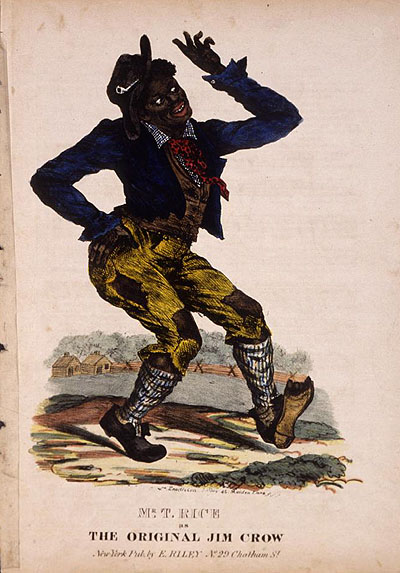
The blackface minstrel image was emblematic of all “low” culture. In contrast with fairly puritanical Victorian social norms, the black stereotype was sensual, giddy, over-indulgent, and unthinking. And that wasn’t just for clown-like, benign fun. A central figure in the legacy of minstrelsy, Thomas “Daddy” Rice, who was most famous for his character “Jim Crow” said:

“[the British] were under the impression that negroes were naturally equal to the whites, and their degraded condition was consequent entirely upon our ‘institutions’; but I effectually proved that negroes are essentially an inferior species of the human family, and they ought to remain slaves”.

T.D. Rice as “Jim Crow”, 1828

Although Rice’s most popular song “Jump Jim Crow” went out of fashion, songs by his contemporary, Stephen Foster, are often still hummed today. Foster signed a contract with the group “Christy’s Minstrels” and published a songbook of hit minstrel songs like “Oh! Susanna”, “Camptown Races”, “Old Folks at Home”, “Old Black Joe”, and “My Old Kentucky Home” in the 1850’s.

By the time Foster’s songs were popularized in America, black folks started participating in minstrel shows. This was one of the few ways that recently freed black folks could earn wages. Although some critics have said that this was a way that black Americans were complicit in their dehumanization, we should also consider that the minstrel stereotype was appropriated from a documented practice of freed men and slaves alike putting on shows for favors, like this rendering of black men dancing at the Catherine Market for eels.

Minstrelsy relegated the black American to a stereotyped primitivism. Despite the unimaginable costs of disenfranchisement, this created a thriving subculture from which sprouted the artistic and intellectual abundance of the Harlem Renaissance. Minstrelsy became a mask that could protect black folks. Adhering to the slavery-era rules and stereotypes of black characters, black individuals could tap a vast market of white people waiting to see them act, dance, and make music. While this was grossly dehumanizing, W.E.B. DuBois contends that black minstrels were able to celebrate and promote themselves and their culture while reclaiming the genre that belittled them.

Furthermore, in his essay titled “Minstrelsy and Early Jazz”, Ostendorf writes that “without the social corset of minstrelsy certain traditions of black oral tradition which we value today for their intrinsic beauty would not have survived the restrictive cultural climate of 19th Century America.” That is to say that multiple scholars argue that black participation in and association with minstrel tropes was necessary and advanced the power and agency of black Americans.

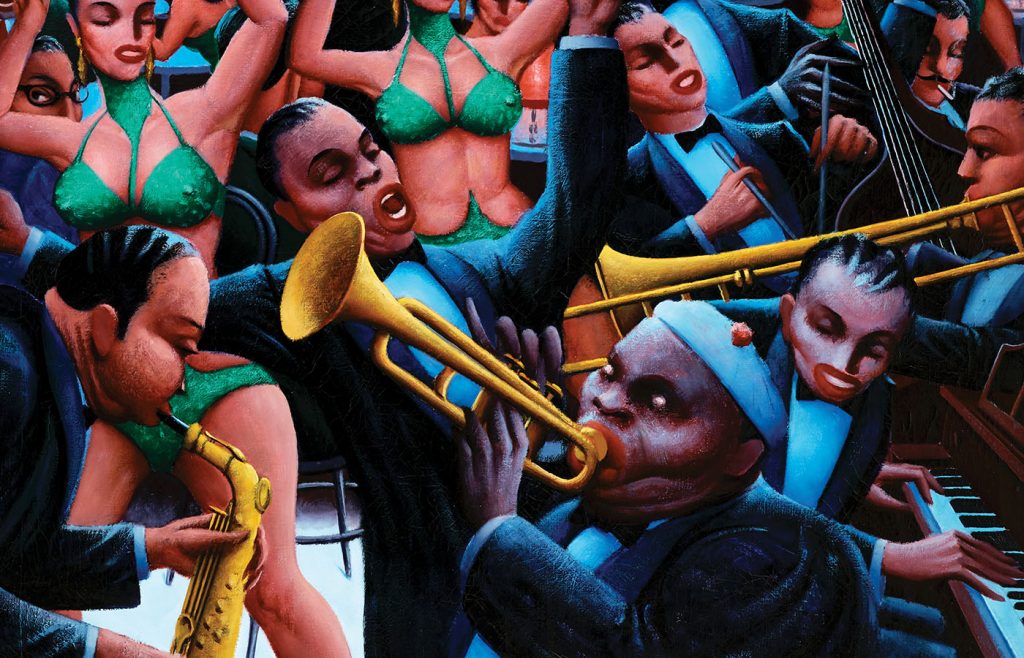
Archibald Motley, “Hot Rhythm”, 1961

Ostendorf also mentions an account from W.C. Handy, the “father of the Blues”, that it “was dangerous for him when he toured the South to appear out of his minstrel role. He tried not to walk alone, not to wear his regular middle class clothes publicly or outside his tent. Whenever his band entered or left a Southern town, they would go in full formation as a band, strike up ‘Dixie’ and be safe from persecution.”

In contrast, a quote from Wynton Marsalis about his song “From the Plantation to the Penitentiary” in “Wynton Throws Down the Gauntlet”: “Like you was Tomin’ and Jessin’ in a minstrel show, now you callin’ yourself a n****r for some money, calling your woman a bitch, shufflin’. You got the gold grill and you’re just Uncle Tomin’, basically. And the culture loves it because they’re used to that. From Stepin’ Fetchit to Flavor Flav. It’s the same. From Zip Coon to the guy from the ghetto who’s going to threaten you. It’s like safari seekers: “Wow, that was a real lion we saw on safari.’ You know, it’s like, ‘Let’s go in the ghetto and see what the natives are doing.'”

In this discussion, Marsalis confronts some of the essential tropes of the minstrel stereotype: primitivism, hedonism, and exoticism. These ideas continue to thrive in some of the roles designed for POC in the entertainment industry. However, these essential conflicts exist symbiotically with the success, affluence, and social influence of POC in that field. Unfortunately, the parallelism doesn’t end at the black caricatures Marsalis discusses; we should also consider that black men are disproportionately persecuted by law enforcement, hate crimes, and gun violence. Handy’s strategy of leaning into a minstrel role would not be viable in a culture that has cultivated a distorted, threatening image of black masculinity.

Stereotypes of black folks are pervasive and profitable in pop culture. They’re even pervasive outside of American music.

In this video by the K-Pop girl group, “Bubble Sisters”, all four members of the group dress in blackface and a strange anachronistic arrangement of costumes. Notably, the actors in the video wear a wide variety of wigs including braids, afros, and even hair curlers, invoking a “mammy” trope. The music quotes elements of R&B and soul in the contour of the melody and in the instrumental accompaniment to such an extent that it’d be hard to miss the references even without the visual cues that place this song within the genre. Furthermore, the inclusion of a tap dancing sequence in the music and video signals a disheartening familiarity with the minstrel genre. While tap dancing was certainly no longer hip in the ’70’s and ’80’s, which is the general era this song aims to evoke, it was a popular element in minstrel performances between 1910 and 1950.

With so much of popular culture flowing from and through the practice of blackface minstrelsy, we must concede that minstrelsy permeates the artistic and political heritage of our nation. The history of minstrelsy is a history of marginalization that is woefully overlooked despite its centuries of cultural influence.